Very happy because it adapts to my schedules because of work, it stimulates me to make an effort and it is for my health. Thank you for existing, I hope more people know about this program.
★★★★★
It's time to sit back, stretch, and let joy do the rest.

Laughter might feel effortless, but it creates a real, measurable response in the body. To explore how moments of joy translate into physical movement, we analysed comedy films over the past century, examining how often audiences laugh and what that could mean for mood, stress, and light activity.
Risa, gelächter, tawa, 笑い, risata — even if we don't recognise every word, we all recognise the sound. Laughter is a universal language, understood across cultures and continents.
While it's often dismissed as a small, everyday pleasure, it has a surprisingly powerful effect on both body and mind, engaging muscles, breathing, and the nervous system in ways that mirror gentle exercise.
Dr. Cassidy Jenkins, clinical psychologist at Yoga-Go, explains what happens beneath the surface when we laugh:
"When we laugh, several areas of the brain involved in emotion and reward become active, including regions linked to pleasure and motivation. This activity can support the release of feel-good chemicals like dopamine, oxytocin, and endorphins, which are associated with improved mood, connection, and even mild pain relief for some people.
"Genuine laughter also creates a brief physical response, your heart rate and breathing increase, but this is quickly followed by activation of the parasympathetic nervous system, the part of the body responsible for calming and recovery. That's why laughter often leaves people feeling more relaxed, lighter, and emotionally uplifted afterward."
But laughter isn't just good for emotional wellbeing, it's also an underrated ally for anyone beginning their fitness journey, as it acts as an entry point into movement.
For many, fitness culture can feel intimidating, high-pressure, or simply unrelatable. Laughter offers a different place to begin, one that feels accessible (you don't even need to leave the house) and free from expectation.
Due to its instinctive, universal, and low-effort nature, laughter provides a safe space that helps people connect with their bodies in a way that feels enjoyable rather than excessive, particularly for those starting out in their fitness journey.
Dr. Cassidy explains: "Reframing movement as something joyful can significantly change how people relate to exercise and how likely they are to stick with it. When gentle movement is paired with something that genuinely improves mood, the brain starts to associate activity with pleasure rather than pressure.
"This reduces stress around workouts and makes movement feel more approachable instead of overwhelming. Over time, that positive association can help turn occasional activity into a routine people actually enjoy and want to maintain."
However, it's important to highlight that laughter-based activity doesn't replace other forms of exercise entirely, but instead, helps to build a foundation. Ultimately, embracing joyful, accessible activities opens the door to a more sustainable relationship with fitness in the long term.
Not everyone feels ready to jump into a gym class or commit to a structured workout routine. Comedy films offer a relaxed, familiar environment where laughter happens naturally without pressure, judgement or effort.
When people watch films in spaces they feel comfortable, their guard naturally drops. This makes room for genuine, unforced laughter, the kind that increases heart rate, deepens breathing, engages muscles, and kick-starts light activity without you even realising.
To understand which films deliver the most laughter (and therefore the greatest potential for joyful movement) we analysed which films deliver the most laughs per minute, allowing us to identify the titles that turn screen time into a surprisingly active experience.
We examined films released over the past century using data from TMDB and Letterboxd. To ensure the results were meaningful, only films with an average rating above 6.5 and a runtime under four hours were included, because realistically, who has the time for anything longer?
To rank them, we developed a confidence score that takes into account each film's rating and the number of viewers who rated it. From there, we created a laughs per minute (LPM) metric, estimating how many laughs each film delivers per minute based on audience responses.
Viewer discretion: Some of the films mentioned include mature themes, adult humour, or content intended for older audiences. Please choose what feels appropriate for you.

Our analysis showed that Disney's Inside Out is the ultimate film for practicing joyful movement. With an estimated laugh per minute of 3.78 and runtime of 95 minutes, it delivers a total of 359.5 laughs on average, resulting in plenty of muscle activation.
Rounding out the top three are two films from the same franchise: The Hangover and The Hangover Part II, which generate 341.4 and 289.6 laughs overall.
Even films further down the list still offer a laugh-filled boost. Classics like In the Loop and the 1997 hit The Full Monty may not top our charts, but they still pack a punch with 214.6 and 215.1 total laughs, proving that even a smaller dose of cinematic comedy can engage the body.
If none of these match your taste, don't worry, we also identified the creators behind the most consistently funny work, in an overall list of 50.
Todd Phillips and Adam McKay lead the way for funniest directors, with two entries each. In the actor category, it's no surprise that Will Ferrell appears twice for his role in Anchorman: The Legend of Ron Burgundy and Step Brothers, but, he's also accompanied by the lead actors from The Hangover and The Hangover Part II, including Bradley Cooper, Ed Helms, and Zach Galifianakis. Christopher Mintz-Plasse has two features too, for Superbad and Role Models.
Bursts of laughter trigger a chain of physical reactions, the kind that subtly strengthen muscles, deepen breathing, and get the body moving without any conscious effort. It's a hidden layer of physical engagement that makes laughter such an interesting bridge between everyday joy and gentle activity.
To unpack how this works, Melissa Leach, yoga expert and strength and conditioning coach, explains how laughing mimics elements of low-intensity exercise:
"Laughter acts like a mini stability workout, breath practice, and mobility session. When we laugh, the diaphragm contracts and relaxes rapidly, much like the paced breathing used in yoga. Genuine belly laughs also create isometric contractions in the transverse abdominis, obliques, and pelvic floor, mimicking the foundational muscle engagement you see in beginner mat Pilates.
"Laughing even wakes up postural muscles. It naturally shifts you out of a slumped position into a more upright posture, mobilising the thoracic spine and engaging the scapular stabilisers. And just like a gentle walk, laughter increases both heart rate and respiration, boosting oxygen uptake and supporting cardiovascular function."
That's not all, research suggests that 10–15 minutes of laughter can burn up to 10 calories. Using this as well as the average duration of a laugh, we were able to estimate that a laugh burns roughly 0.2 calories. By applying this figure to the total laughs in a film, we can see just how many calories comedy films can burn, and what they equate to.
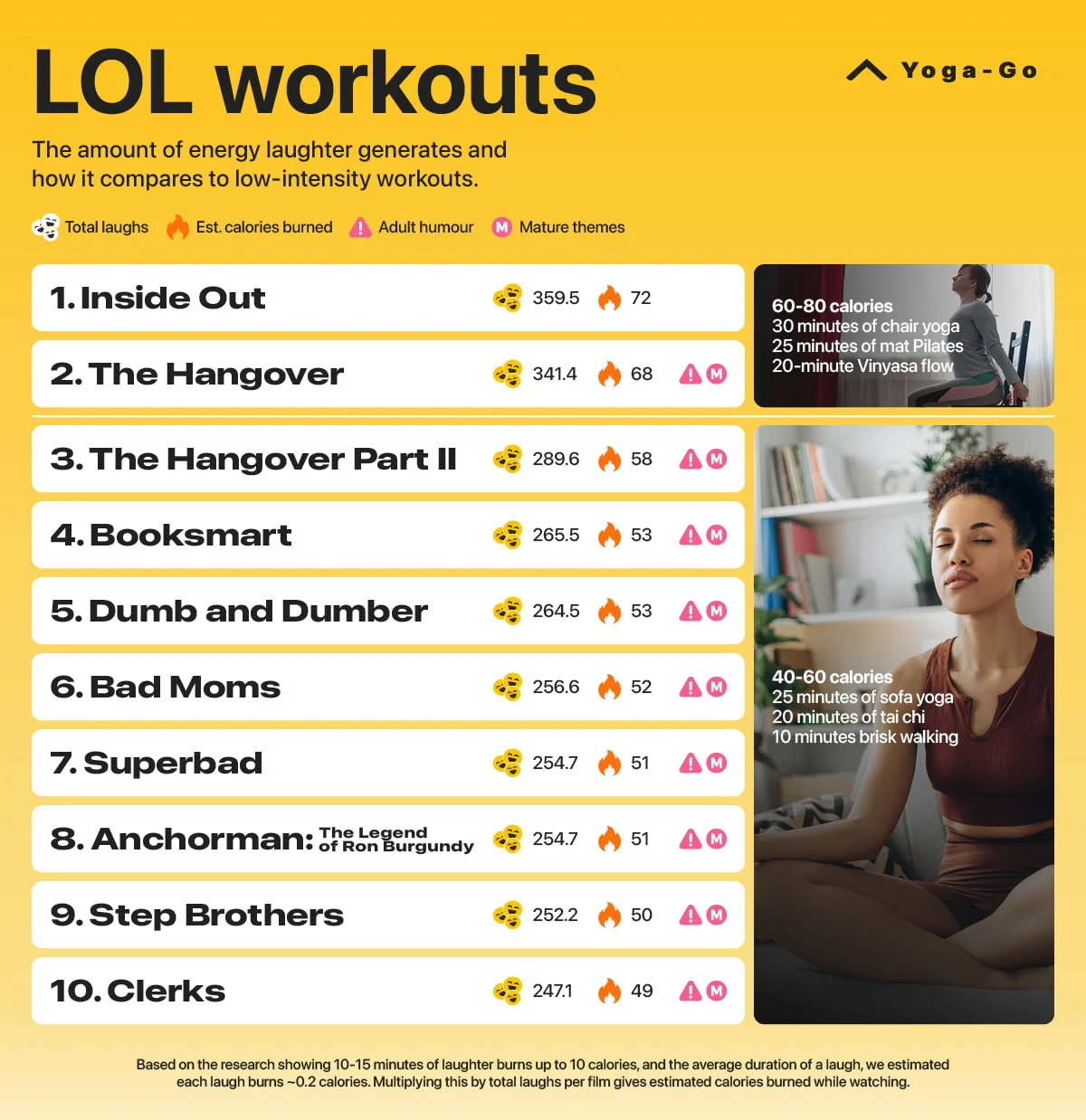
Take Inside Out or The Hangover, each clocks over 340 laughs on average, equating to an estimated 72 and 68 calories burned respectively, which is roughly the equivalent of 25 minutes of mat Pilates or a 20-minute Vinyasa flow.
Films in the next tier, like The Hangover Part II or Booksmart, are estimated to burn 58 and 53 calories in that order, whereas Clerks sits at just under 50, all of which are on par with 25 minutes of sofa yoga or 20 minutes of tai chi.
It's important to note that these are estimates, the actual calories burned will vary from person to person based on physiology and the intensity of laughter or exercise.
While laughter on its own already burns calories, some people may want to build on that foundation in a way that feels relaxed and accessible. To support this, Melissa has developed a dedicated laughter workout: a sofa yoga sequence designed to be done while watching your favourite comedies at home.
Melissa explains: "Sofa yoga is an excellent and accessible entry point into movement. The support of the sofa reduces joint load, creates a sense of comfort, and removes the intimidation barrier, which is key for consistency.
"Gentle twists, folds, and side bends help regulate the nervous system, improve spinal mobility and make breathwork easier. Even simple seated movements, like calf rises, can boost circulation and support metabolic health. Think of it as a safe, welcoming way to begin moving your body.
"Many yoga poses can be adapted to a seated position, such as seated cat-cow, reclined twists, or marching legs. Others, like planks, lunge poses, knee heavy movements, or weight-bearing wrists poses, require a firmer surface and are best done off the sofa."
During opening credits, 2–3 minutes.
Alternate and repeat as laughter happens.
Closing credits, 2–3 minutes.
Whether you're easing into movement, rebuilding your routine, or simply looking for a more joyful way to unwind, laughter offers a simple and uplifting place to begin. Pairing it with accessible, sofa-friendly exercise transforms a moment of amusement into something meaningful for both body and mind.
So the next time you hit play on your favourite comedy, take a breath, get comfortable, try a few light movements, and let joy do the rest.
To explore which comedy films deliver the most laughs, we analysed movies from TMDB and Letterboxd, focusing on releases from the past century. Our research focused on comedy films, as these are designed to make audiences laugh. To ensure our findings were meaningful, we included only films with at least 100 ratings, an average rating above 6.5, and a runtime under four hours.
We then developed a confidence score, our primary measure for ranking films. This score accounts for both the movie's rating and the number of viewers who rated it, while adjusting for any outliers that would skew the result. Using the confidence score, we created a laughs per minute (LPM) metric, estimating how many laughs a film delivers each minute based on audience response.
Finally, we connected laughter to physical impact. Drawing from research showing that 10–15 minutes of genuine laughing can burn up to 10 calories and based on the average duration of a laugh, we estimated that each laugh burns roughly 0.2 calories. By multiplying this figure by the total laughs generated by each film, we could estimate the calories burned while watching.
1. PubMed

Dr. Cassidy Jenkins, PhD, is a clinical psychologist, educator, and mental health consultant who specialises in the mind–body connection, behaviour change, and making mental health tools practical and accessible. Her work focuses on helping people build sustainable routines, reduce stress, and improve well-being through realistic, evidence-based approaches.

Melissa is a certified yoga instructor and strength & conditioning coach with extensive experience in the health and wellness field. She specialises in yoga education, teacher training and holistic lifestyle coaching, drawing from styles such as vinyasa and ashtanga. Over the years, she has worked with a wide range of communities, including children, veterans, and athletes. Melissa is passionate about creating safe, empowering spaces where individuals can reconnect with their bodies, build strength, and develop greater self-awareness.
Yoga-Go was built with users in mind. See what they have to say about their experience with the app.